Browsing Category

HEALTH

Love/ Spiritual

Clanging Cymbals and Missing Mittens

{From I Corinthians 1}
“If I speak…and do not have love, I have become a noisy gong or clanging cymbal”

To speak without love is like a noisy gong or a clanging cymbal.
Harsh.  Off-putting.
With a gong, the initial sound is so harsh that the beauty of the echo or the sound of it fading away is hard to focus on.  I think it is the same with our words.  If they are not wrapped in love, the sound of them are harsh and hard to hear, useless and pointless.
Even if they are words of truth, people will not be able to hear the beauty of the ‘echo’ because they have been so jarred by the initial tone.
So…
My words must be in love to be heard.
My words without love are jarring, disconcerting, irritating, unheard.
I want those around me to associate my words with truth, beauty, love and gentleness.
I DON’T WANT TO BE A GONG!
I want to speak truth in love, gently.
This morning my words were a clanging cymbal, in the car of all places.  My poor girls, stuck in a car with their mommy clangin’!  Hitting my gong over–of all things–missing mittens.
Ok, moms, I know you are with me.  Is there anything more maddening than missing mittens??
The pocket method has been working well for us, until lately.  It seems to work when we have consistent freezing weather, because we use them all the time, but the minute it is a bit less freezing, all of the sudden our mittens disappear!  We even have a very accessible mitten drawer this year, that contained (notice past tense), extra pairs of gloves and mittens.  Now it is a drawer of single mittens with missing matches.  How does that happen?
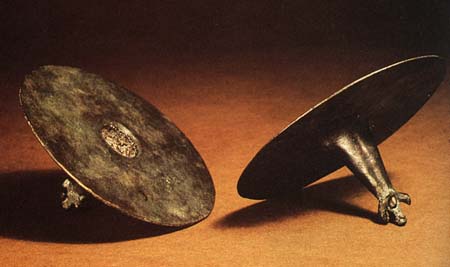
After dropping my mitten-less girls off at school, I came home and found my youngest girls mittens in her coat pockets, right where they should be; she just chose to wear a different coat. (hanging head)  I will sit them down today after school, share this verse with them, admit I gonged, and ask for forgiveness.  Then we will discuss how to be more responsible with our mittens.  This time they may hear me, since I won’t be using these:

Then I’m going to search amazon for a mini version of the top picture.  Wouldn’t that be a great visual reminder of how irritating loveless words are?  Maybe I could even go beat on it to interrupt the trio of loveless sister words that happen from time to time around here…:)
Love/ Spiritual

Prayer Bench

I have found a spiritual mentor in blogosphere. Her name is Ann Voskamp and her blog is called “Holy Experience.” I have talked about her here, and continue to be a huge fan. The way she writes and experiences God just hits a chord with me. I feel she is able to put on paper emotions, feelings and thoughts I have but can’t express. She expresses her heart beautifully, I just jive with her! I am so thankful to have found her and can learn from her.

I’ve been reading through her series of spiritual practices with an eye out for posts on prayer. She, of course, did not disappoint. She’s written much about prayer, but this post made my heart yearn for what she had. She wrote about creating a space in her home specifically for the act of prayer. I finished reading the post with a longing for one of my own. A day later, I have one.

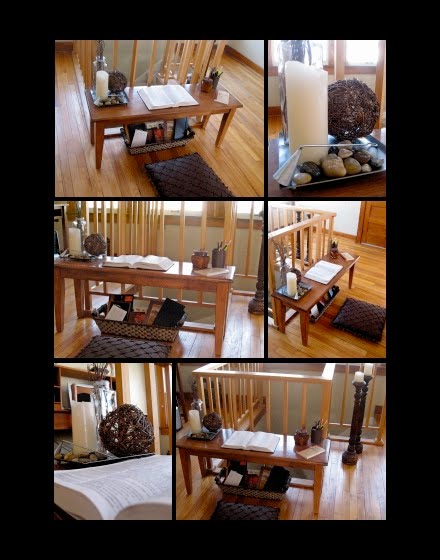
We have a landing area upstairs that tends to be unused space. I walk through it numerous times a day to get to my bedroom. It is a favorite space of mine, because of the many windows that allow light to stream in. Yesterday it was full of Christmas bins waiting to be put into the attic. Today, it is an intentional meeting place with my God. I had some time there with Him today. It was peaceful and I felt great anticipation of precious time to come. I had just finished that time when I received an email from a friend whose family is experiencing the pain of cancer. I knew where I would go to kneel and ask God to give them peace, and back up the stairs I went. I know I can pray anywhere, anytime, but there is something special about having a place, an intentional place.
For me:
  • It is a place that says “God, I want to meet with you”
  • It is a place that allows me to stop and kneel for sixty seconds in the midst of busy life.
  • It is a place that draws me to sit and stay, to meditate, journal, read and pray.

It is also place where others have been…
John Piper writes…

“…when we bought our first home, I built a prayer bench with a place for my elbows in a kneeling posture, and a place for my bible to lie, and a shelf underneath for the Bible or other books and a notepad… There the prayer bench welcomes me every morning and several times during the day. God alone knows the tears and songs that have mingled there. I urge you to think creatively.

Seriously consider building a place of prayer…”

I considered.

I found:

  • A bench we have had sitting in our sunroom.
  • A basket given to me by my mom for Christmas.
  • A candle and matches.
  • Books, Bible and journal.
  • Pens and highlighter.
  • Rocks that remind me to “remember the works of the Lord.”
  • A pillow given to me from a friend.

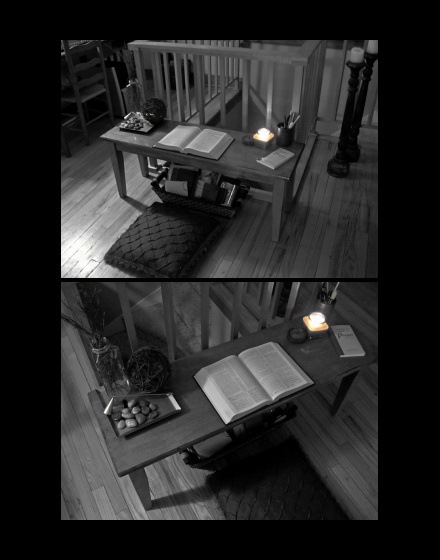
And now I have a simple meeting place- A prayer bench.

This post is linked to:
Finer Things Friday @ The Finer Things In Life
Show And Tell Friday @ My Romantic House

HEALTH/ Healthy Eating/ How-Tos/ RECIPES

Healthy Eating -White To Brown: Make your grains count

I have been asked by readers to post some easy, practical baby-steps for them to take on their road to healthy eating. Here are some we started with…
Get Rid Of White and Embrace Brown!
  • Brown rice instead of white rice
  • 100% Whole wheat pasta instead of plain
  • 100% Whole wheat bread instead of white
  • Whole grain, fiber- rich cereals instead of sugar cereals
  • Whole wheat flour instead of white flour
If that is too overwhelming, just start with one. Give your family a chance to get used to it.
Whole Wheat Pasta
When I switched from white pasta to brown, the first few times I mixed the two together to introduce it to the family. I also let them get heavy handed with the parmesan cheese.:) They did complain that it tasted different the first couple times, but got used to it. Now, they don’t even remember complaining about it!
100% Whole Wheat Bread
This one is so important if you are a family that eats a lot of toast and sandwiches. White bread is just a bunch of empty calories, very little fiber, and does not keep you full.

Read Labels!! (while you are checking out fiber content ..aim for 3 grams/serving-also look for high fructose corn syrup, which you want to avoid!)

In comparing bread ingredient labels, use the same judgment tip we mentioned in comparing yogurt labels: the shorter the ingredient list, the better the bread. The most nutritious bread may be made from only whole wheat flour, water, yeast, and salt, with possibly a touch of molasses and honey, or the addition of other “whole” grains. The key-word on the bread label is “whole.” Be particularly careful of the most recent little white label lie called “wheat flour,” which does not mean the same as whole wheat. Wheat flour, which gives bread a light brown color and therefore more health appeal, is 75 percent white flour and only 25 percent whole wheat. So it’s only 25 percent healthy bread instead of 100 percent. By looking at labels, you can group breads into three categories:

  • Best breads are 100 percent whole wheat. Whole wheat flour is the first ingredient on the label. Enriched flour does not appear in the ingredient list. If it doesn’t say “whole wheat,” it’s not. Wheat flour, as listed on labels, officially should mean 75 percent white and 25 percent whole wheat, but it may not. All white bread is “wheat flour,” so this term is misleading, at best. A truthful label would state what percentage is whole wheat. If a label says “wheat flour,” assume it’s not whole wheat.
  • Better breads list “whole wheat flour” as the main ingredient, but may include white flour, too.
  • Downright junk breads list “bleached, enriched flour” first in the ingredient list. Leave these on the shelf where they belong. If it doesn’t say “whole” on the label, it’s wrong for your body.
Brown Rice
This one is a big one. There is just so much benefit from eating brown rice! I have a rice cooker that is so easy to use. I love using homemade chicken stock instead of water, or adding a can of rotel tomatoes w/green chilies with the water.

(from whfoods)

The process that produces brown rice removes only the outermost layer, the hull, of the rice kernel and is the least damaging to its nutritional value. The complete milling and polishing that converts brown rice into white rice destroys 67% of the vitamin B3, 80% of the vitamin B1, 90% of the vitamin B6, half of the manganese, half of the phosphorus, 60% of the iron, and all of the dietary fiber and essential fatty acids. Fully milled and polished white rice is required to be “enriched” with vitamins B1, B3 and iron.

Healthy, Whole Grain Cereals
Get rid of sugar cereals! I personally can’t stand the idea of my girls eating these for breakfast b/c I know the sugar rush I get when I eat them, and I also know the let down shortly after. I picture them sitting at school, tummy’s growling by 10:00 a.m. distracting their little brains, just because of a choice I made when adding groceries to my cart. When you are eating these type of cereals every day, then switch to a fiber rich, whole grain, low- sugar cereal, you will notice a difference when you try to go back to the sugar cereal. It will taste good (maybe), but won’t be satisfying and won’t make you feel good or full.
My girls get tired of the same type every week, so I try to mix it up. Right now they are on a Raisin Bran kick. Cereal was another food that took some time for them to adjust to. Now they “get it”. My oldest daughter was at a sleepover this past summer and ate a donut and a bowl of fruit loops or lucky charms or one of those yummy fun cereals. I had to pick her up mid-morning for a swim lesson (she is in level 4 which is pretty intense laps most of the 45 minutes). The first thing she said to me when she got in the car was, “mom, I need some good food or I will not have the energy to swim” She loved the donut and fun cereal, but also knew it just wouldn’t do the trick for swimming stamina.
Whole Wheat Flour
This one has been the hardest for me. I am finally figuring out brands I like, and how the different types of whole wheat flour work in different recipes. I am a big fan of Bob Mill’s Flours. I have yet to find a whole wheat pizza dough recipe I love, I’ve found a few likes, but no love’s.:(
It does make the world of difference when it comes to homemade pancakes, waffles, breads and muffins. These are foods that would be very empty nutritionally if not for a good, whole wheat flour. I still keep white flour on hand, but I make sure it is unbleached.

As I reflect back on when we started changing how we ate, there was a big shift in my thinking when it came to being purposeful in choosing foods and recipes that would nourish, not just fill. You can fill a car up with gas, but the quality of the gas makes all the difference in how that car runs. Same with our bodies. I have used that analogy with my girls one too many times, because now they say roll their eyes when they hear me say it.:) We talked about how a car would crawl and sputter if filled with gas that had a bunch of sand in it, same with our bodies when it comes too much sugar and not enough vegetables, fruits and healthy, pure foods. They get it. Makes a momma proud!
I hope this post helps and is not too overwhelming. Again, if it is, just pick one and go from there.


Love/ Spiritual

A New Year

I want meet with Him everyday.
I want to take on His strength.
I want to love what He loves.
I want this, because I know Him.

“God is not a belief to which you give your assent. God becomes a reality whom you know intimately, meet everyday, one whose strength becomes your strength, whose love, your love. Live this life of the presence of God long enough and when someone asks you, “Do you believe there is a God?” you may find yourself answering, “No, I do not believe there is a God. I know there is a God.”

~Ernest Boyer, Jr.


HEALTH/ Healthy Eating/ How-Tos/ RECIPES

Healthy Eating- Health Books I Jive With

These are a few of my favorite books on health. They all have helped mold my thinking about food and healthful living. This is not to say I agree with EVERYTHING they say, some even contradict each other, but the knowledge I have gleaned from them is what I have been putting into practice when feeding my family, and SOMETHING is working! Praise God.

You:The Owner’s Manual

I admit, I’m a Dr. Oz fan. I even tape his show. I love all the videos he does to show how the amazing body works internally. I learn so much from his books. He uses comic type pictures to really help a regular joe (or sue:)) understand why our bodies do what they do, how different organs work, and the cause and effect of things we put into our bodies.

You:On A Diet

Same as above but with more focus on food and diet. I even got my husband to read this one. He enjoyed it, and used some of what he read to help him lose 25 pounds.  He looks great! Now he does not look at me with a blank stare when I want to talk health–he gets it, most of it.:) I only get an occasional blank stare..

You:Staying Young

This one was a fun read for me. It talks beauty which I’m always up for..

The Unhealthy Truth

Are you glad I moved on from Doc Oz?
I devoured this book. I don’t know what to think of some of its content, but major light bulbs went off for me when it came to my daughters asthma and allergy symptoms. Because of this book I no longer use cleaning products with chemicals in them, which I KNOW has played a big part in getting my daughter off inhalers. It also made me more aware of food allergies, and because of that I now know the horrid coughing fits my daughter would randomly, but often, have were do to yellow food coloring and maybe corn. (ugh, I so sound like one of THOSE mothers I used to roll my eyes at)

In Defense Of Food

Another very intriguing book. One my husband rolls his eyes at, and one I raise my eyebrows at while saying “Hmm..”  I liked this book.

Animal, Vegetable, Miracle

This one was just a fun read. It let me fantasize about living on a farm and growing my own food. I would love that, really I would, but I will settle for a garden–even if it has to be a community garden!

Real Food

This is one I am reading now. Can’t seem to finish it because I am always blogging!

Nourishing Traditions

This one is next on my list. I hear it is pretty hard core. Bring it on…

So as I was checking to make sure all the links worked in this post, and I was so pleased to see that all of these books were reviewed by many on Amazon.com, and most got four and three quarters stars!  A couple got 5 stars, and one (You:Staying Young) got 4 stars.  That makes me happy! I feel less alone and less quacky in this quest, to simplify the foods my family eats, and to figure out which ones are most helpful to our health.

HEALTH/ Healthy Eating/ How-Tos/ RECIPES

Heathy Eating-2 Ingredients To Avoid

Did you read Part 1?

This post is about 2 things that really, really need to be eliminated from our diet, but instead, they DOMINATE the American diet. The good news is, if you read labels and turn away from foods that contain these ingredients, your home will automatically be one that contains mostly whole, unprocessed foods. The bad news is, they are both in A LOT of foods. In our family, we started slow with this one. It is a process. We are still in the middle of the process. This post will tell you what they are, and if you decide you want to avoid them, there will be links for additional reading.

1. High Fructose Corn Syrup
High fructose corn syrup (HFCS) is a type of sugar that has been processed and combined with corn syrup to produce a cheap, easily dissolvable sweetener. But this sugar is quickly absorbed by the liver where it is converted into fat. Since your brain doesn’t recognize HFCS as regular food, it never shuts off the appetite center — so you keep eating. Blood sugar levels rise, massive amounts of insulin is recruited to metabolize it and then you crash and feel hungry again. Avoiding it (and all simple sugars for that matter) not only keeps you from a mountain of calories, but because they induce highs and lows in blood sugar and put you into a cycle of craving more high-calorie foods, will stabilize your cravings, moods and energy levels. It is found in soft drinks, fruit juices, salad dressings and baked goods. Wanna get healthy? Read the food labels of products in your pantry and refrigerator and throw out all products that contain HFCS.

I admit, this one is a hard one. During the holiday season it arrived back at our house in candies and all sorts of other ways. I try hard to check labels and keep this ingredient out of my grocery cart, but to say we avoid it completely is not true. (It’s even in ketchup, and bread!)

Pop is a biggie. I just love a can of pop with my pizza, but drinking it is like drinking a can of HFCS! Reading through all this HFCS information again is very motivating for me to cut the pop. The diet stuff is no better because of the artificial sweeteners in in. There are some very yummy carbonated beverages sold in health food stores that use pure cane sugar, which is still a simple sugar, but better then HFCS, so I will fall back on this when I am at home and want something bubbly. (seelink below for brands)

For more reading on HFCS:
Very thorough post on HFCS
Here is a list of products with No HFCS–quite helpful!

7. Non-Hydrogenated Oils
Trans fat is a type of unsaturated fat that is made saturated during a manufacturing process that adds a molecule of hydrogen. These hydrogentated oils raise bad cholesterol and lower good cholesterol and cause a host of cardiovascular diseases. They are slowly being removed from commercial recipes but products in your home may still contain them.
Avoid shortening, margarines, and vegetable oil. All hydrogenated oils.  Soy, Corn, Cottonseed, and  Safflower oil. Read labels, not just the amount of trans fats but also the ingredient list.  Skip foods that contain non-hydrogenated oils.
Click here for a great post on healthy oils from Passionate Homemaking.
I had been using Canola oil in my baking, but due to some controversy over whether it is healthy or not, I need to read up on that.  I also use olive oil, coconut oil and real butter.
Yup, BUTTER!
 Here is where the conclusions for my own family and what we eat may raise a few eyebrows, since it goes against much of what is familiar and accepted.
  • We use butter-real butter
  • We use buttermilk
  • We use whole milk
  • We eat grass-fed beef (in moderation)
  • We eat eggs, lots of eggs
Most would read that and think “ohhh…big- time saturated fats and cholesterol!” but…
We are healthier then we have ever been. I will write a post on my family’s poor health history (it seemed we lived at the dr’s office!) and how it has changed drastically since we started eating what I call “traditional foods” (or “whole foods” or “real foods”).

It is that time of year where everyone is making New Years Resolutions and cutting calories. I believe that is not the answer. Yes, moderation is good, but I believe the answer is stressing the quality of the food we eat, not so much the quantity, because if you are eating quality food, the quantity seems to regulate itself. It is amazing how full we stay on these types of food, and by avoiding HFCS (which trigger cravings) and filling up on good food, we end up eating less and staying full much longer. When our bodies got used to eating this way, it was amazing how the food that used to “call our names” no longer have that appeal, and now my body (and my kids bodies!) crave what it should crave. Don’t get me wrong, they will still be delighted with candy and sweets,(that is what Grandma’s house and parties and holidays are for!;)) but here at home, they ask for fruit and snacks that make them feel good, and have even complained about how junk food makes them feel. (loved that!)

For now, here is some reading from the Weston A. Price Foundation. I am not a die hard Weston Price fan, but a lot of what they represent makes sense to me and is working for us. Here is some of what their site has to say about fats, (and why I am very comfortable feeding my family the above foods).
Rise of Coronary Heart Disease in the 20th Century – by the Weston A. Price Foundation
Scientists of the period were grappling with a new threat to public health—a steep rise in heart disease. While turn-of-the-century mortality statistics are unreliable, they consistently indicate that heart disease caused no more than ten percent of all deaths, considerably less than infectious diseases such as pneumonia and tuberculosis. By 1950, coronary heart disease, or CHD, was the leading source of mortality in the United States, causing more than 30% of all deaths. The greatest increase came under the rubric of myocardial infarction (MI)—a massive blood clot leading to obstruction of a coronary artery and consequent death to the heart muscle. MI was almost nonexistent in 1910 and caused no more than three thousand deaths per year in 1930. By 1960, there were at least 500,000 MI deaths per year in the US. What life-style changes had caused this increase?
Since the early part of the century, when the Department of Agriculture had begun to keep track of food “disappearance” data—the amount of various foods going into the food supply—a number of researchers had noticed a change in the kind of fats Americans were eating. Butter consumption was declining while the use of vegetable oils, especially oils that had been hardened to resemble butter by a process called hydrogenation, was increasing—dramatically increasing. By 1950 butter consumption had dropped from eighteen pounds per person per year to just over ten. Margarine filled in the gap, rising from about two pounds per person at the turn of the century to about eight. Consumption of vegetable shortening—used in crackers and baked goods—remained relatively steady at about twelve pounds per person per year but vegetable oil consumption had more than tripled—from just under three pounds per person per year to more than ten.1
The statistics pointed to one obvious conclusion—Americans should eat the traditional foods that nourished their ancestors, including meat, eggs, butter and cheese, and avoid the newfangled vegetable-oil-based foods that were flooding the grocers’ shelves; but the Kritchevsky articles attracted immediate attention because they lent support to another theory—one that militated against the consumption of meat and dairy products. This was the lipid hypothesis, namely that saturated fat and cholesterol from animal sources raise Hydrogenation and Trans Fats
Most animal fats—like butter, lard and tallow—have a large proportion of saturated fatty acids. Saturated fats are straight chains of carbon and hydrogen that pack together easily so that they are relatively solid at room temperature. Oils from seeds are composed mostly of polyunsaturated fatty acids. These molecules have kinks in them at the point of the unsaturated double bonds. They do not pack together easily and therefore tend to be liquid at room temperature. Judging from both food data and turn-of-the-century cookbooks, the American diet in 1900 was a rich one—with at least 35 to 40 percent of calories coming from fats, mostly dairy fats in the form of butter, cream, whole milk and eggs. Salad dressing recipes usually called for egg yolks or cream; only occasionally for olive oil. Lard or tallow served for frying; rich dishes like head cheese and scrapple contributed additional saturated fats during an era when cancer and heart disease were rare. Butter substitutes made up only a small portion of the American diet, and these margarines were blended from coconut oil, animal tallow and lard, all rich in natural saturates.
The technology by which liquid vegetable oils could be hardened to make margarine was first discovered by a French chemist named Sabatier. He found that a nickel catalyst would cause the hydrogenation—the addition of hydrogen to unsaturated bonds to make them saturated—of ethylene gas to ethane. Subsequently the British chemist Norman developed the first application of hydrogenation to food oils and took out a patent. In 1909, Procter & Gamble acquired the US rights to the British patent that made liquid vegetable oils solid at room temperature. The process was used on both cottonseed oil and lard to give “better physical properties”—to create shortenings that did not melt as easily on hot days.
After the second world war, “improvements” made it possible to plasticize highly unsaturated oils from corn and soybeans. New catalysts allowed processors to “selectively hydrogenate” the kinds of fatty acids with three double bonds found in soy and canola oils. Called “partial hydrogenation,” the new method allowed processors to replace cottonseed oil with more unsaturated corn and soy bean oils in margarines and shortenings. This spurred a meteoric rise in soybean production, from virtually nothing in 1900 to 70 million tons in 1970, surpassing corn production. Today soy oil dominates the market and is used in almost eighty percent of all hydrogenated oils.
The particular mix of fatty acids in soy oil results in shortenings containing about 40% trans fats, an increase of about 5% over cottonseed oil, and 15% over corn oil. Canola oil, processed from a hybrid form of rape seed, is particularly rich in fatty acids containing three double bonds and the shortening can contain as much as 50% trans fats. Trans fats of a particularly problematical form are also formed during the deodorization of canola oil, although they are not indicated on labels for the liquid oil.2
Certain forms of trans fatty acids occur naturally in dairy fats. Trans-vaccenic acid makes up about 4% of the fatty acids in butter. It is an interim product which the ruminant animal then converts to conjugated linoleic acid, a highly beneficial anti-carcinogenic component of animal fat. Humans seem to utilize the small amounts of trans-vaccenic acid in butter fat without ill effects.
But most of the trans isomers in modern hydrogenated fats are new to the human physiology and by the early 1970’s a number of researchers had expressed concern about their presence in the American diet, noting that their increasing use had paralleled the increase in both heart disease and cancer. The unstated solution was one that could be easily presented to the public: Eat natural, traditional fats; avoid newfangled foods made from vegetable oils; use butter, not margarine. But medical research and public consciousness took a different tack, one that accelerated the decline of traditional foods like meat, eggs and butter, and fueled continued dramatic increases in vegetable oil consumption.

HEALTH/ Healthy Eating/ How-Tos/ RECIPES

Healthy Eating-Disclaimer

I read…a lot. I’ve read A TON of health books, so much so that my husband just shakes his head and chuckles every time I bring a new one home from the library. Over the last few years, my mind has been able to sort through all the information that I have gathered, and I’ve gradually come to a point where I was am no longer paralyzed by the information, but at peace and comfortable with the conclusions I have come to and what I believe about food.

I love feeding my family. There is a lot of responsibility when it comes to being the “feeder.” I am the one who makes the list, buys the groceries and cooks the food. I know my decisions will affect the ones I consider most dear in this world in big ways, not only in their health right now, but also their future health and even the health of my children’s children.

I have wanted to share with you what I have come to embrace when it comes to healthful eating, but boy, it has been a struggle to know even where to start, especially when I am fairly new at this whole thing myself. Thankfully, I have found some amazing women bloggers who think like I think, who jived with the books I jive with, and who have been doing this much longer than I have. I will share with you the changes that we have made in our eating habits, and then give you links to these blogs whose thoughts, words, and ideas mirror mine, and who have done a great job of articulating them, much better than I ever could. Many will come from this blog…
Heavenly Homemakers— I read it everyday. Why?
  • She is hi-lar-i-ous.
  • She is wise.
  • She is Godly.
  • She lives in NEBRASKA!
  • She cares deeply for her family and their health.
  • She likes mason jars as much as I do.
  • She has great recipes that do not take a million ingredients.
  • She has recipes that I make and love, then steal for share on my own blog. *see pretzels and popcorn chicken, and soon…brownies!
  • She believes what I believe when it comes to food,(and most other things, as well).
  • She has done a Getting Real With Food series, which gave me such a relief when I read through it. It is so well done (and says many of the things I want to say but instead, I just sit and stare at my computer screen with furrowed eyebrows whenever I try) that I will be constantly linking my series with hers.
So click here, and read this post that she begins with “I DON’T KNOW EVERYTHING,” and pretend I am sitting next to you whispering excitedly, “ditto” and “I agree!” and “my thoughts exactly!” after each point she makes. Then, if you like what she is saying, feel free to leave her a comment letting her know you do–bloggers love comments, they keep us going!


Top